In-House Marketing vs Agency vs Fractional CMO: Which Model Fits Your Stage?
A six-person in-house marketing team costs about $812,800 a year fully loaded. Here's how that compares to an agency or a fractional CMO, when in-house wins, and how to choose by stage, growth goal and sales cycle.
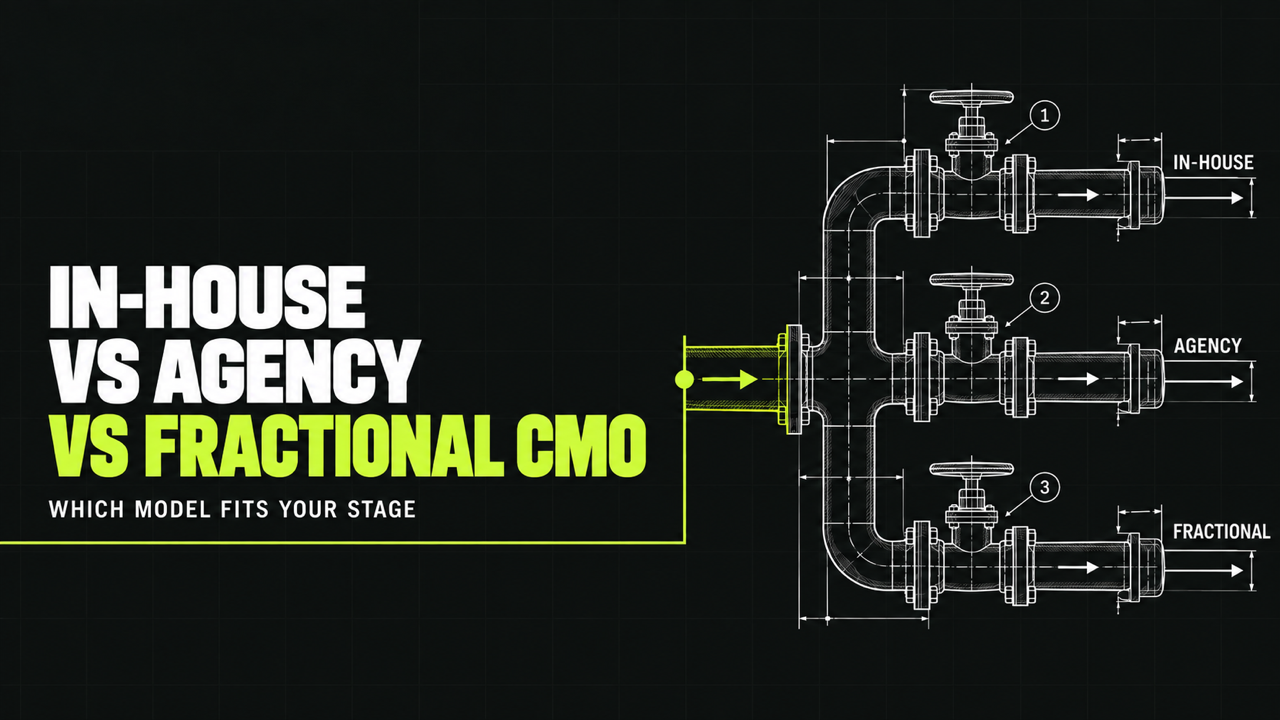
Many leadership teams frame this as a cost question: is an agency cheaper than hiring? That’s the wrong place to start. The better question is what outcome you need, and which model can deliver it at your stage.
We hear the cost framing constantly, along with a close cousin: “we need to hire a paid ads person” or “we need an SEO agency.” Those are tactics. Sometimes they’re the right ones. Often an honest look at the numbers shows the constraint is somewhere else entirely, like a website that doesn’t convert or a sales team that can’t follow up. Decide on the outcome first, and the staffing model gets much easier to pick.
Here’s the short answer:
| Situation | Model that usually fits |
|---|---|
| You need one or two channels run well, every week, for years | In-house hire |
| You need a strategy and someone senior to own it, and you already have people to execute | Fractional CMO |
| You need strategy plus execution across several channels, fast | Agency |
| You have a strong marketing leader but not enough specialists | In-house lead plus agency execution |
| You don’t know what’s broken yet | Start with an audit or paid diagnostic before committing to any model |
The true cost of an in-house marketing team
A salary is only part of what an employee costs. The Bureau of Labor Statistics’ latest employer cost data shows that for management and professional roles, benefits make up 31.5% of total compensation. Put another way, benefits and legally required costs add about 46% on top of base pay, before recruiting, software, equipment, training or management time.
Here’s what it costs to staff the specialist roles an integrated agency typically brings, using Robert Half’s 2027 Salary Guide midpoints:
| Role | Salary (midpoint) | Fully loaded (salary ÷ 0.685) |
|---|---|---|
| Marketing director | $134,500 | $196,400 |
| Digital marketing manager (paid media) | $103,750 | $151,500 |
| Marketing automation specialist (CRM) | $86,000 | $125,500 |
| Content manager | $85,500 | $124,800 |
| SEO specialist | $78,500 | $114,600 |
| Graphic designer | $68,500 | $100,000 |
| Total | $556,750 | $812,800 a year, about $67,700 a month |
Very few mid-market B2B companies need six full-time specialists. That’s the point. An agency spreads those specialists across several clients, so you get the skills without paying for six full salaries.
Then there’s time. SHRM’s 2025 recruiting benchmarks put the median time to fill a role at about 45 days, and a new hire still has to learn your market, your buyers and your systems after day one. If a marketing director leaves, you’re starting over. CMO Huddles data reported by MediaPost puts median CMO tenure at about three years, with 30% in the role under 18 months.
None of this means in-house is a bad deal. It means the comparison has to use fully loaded costs on both sides, and include the months it takes before a new team is productive.
What an agency gives you that’s hard to hire for
A good agency gives you three things a single hire can’t: specialist depth across channels, speed, and pattern recognition from working across many companies.
Specialist depth. One great marketer can be strong in two or three areas. A paid search strategist, an SEO lead, a CRM architect and a technical copywriter are four different people, and an agency can put all of them on your account for a fraction of what four salaries would cost.
Speed. A team that’s already built can start in weeks. Hiring the same team takes months, one role at a time.
Pattern recognition. An agency sees what’s working across dozens of accounts at once. When search behavior shifts, it notices fast. In The Great Declick, we compared a year of Search Console data across 18 B2B accounts and found informational click-through down 38% at stable rankings. One in-house team, watching one account, would have a much harder time telling a market shift from its own problem.
The tradeoff is context. An agency won’t know your product, customers and internal politics as well as an employee who’s been there five years, at least not at first. The good ones close that gap with buyer interviews, time with your sales team and a dedicated team that stays on your account. Ask how they’ll do it. It’s worth reading our buyer’s guide to choosing an agency before you start talking to them.
Where fractional CMOs fit, and where they fall short
A fractional CMO gives you senior marketing leadership part time. It’s a strong fit when you need someone to set strategy, build the plan, manage people or vendors, and report to the leadership team, but can’t justify a full-time executive salary.
It’s a growing option. CMO Huddles and Findem data, reported by MediaPost, shows fractional or interim leaders made up about 8% of CMO hires in 2026, up from about 3% in 2020.
Pricing varies widely, and there’s no rigorous independent survey. Go Fractional’s rate benchmark shows a median of $175 an hour, with typical engagements around 21 hours a week, which works out to roughly $15,900 a month. MarketerHire says most part-time CMOs charge $3,000 to $15,000 a month. Compare that to the roughly $16,400 a month it costs to employ a marketing director at the Robert Half midpoint, fully loaded.
Where fractional CMOs fall short is execution capacity. A great strategist working 20 hours a week can tell you exactly what to do. Someone still has to run the campaigns, write the content, build the CRM workflows and fix the website. If you don’t have that team already, a fractional CMO ends up as an expensive project manager for freelancers, or a strategist with no one to execute the strategy.
The best fractional engagements we see pair a fractional leader with a capable in-house team or an execution partner.
Hybrid models: an in-house lead plus agency execution
For many mid-market B2B companies, the strongest setup is a hybrid: one in-house marketing leader who owns the strategy and knows the business, plus an agency that brings specialists and execution capacity.
The in-house lead keeps context the agency would otherwise have to rebuild: product knowledge, relationships with sales, and the history of what’s been tried. The agency brings the paid, SEO, content, CRM and creative depth that would take five more hires to match. The lead holds the agency accountable to the plan, and the agency gives the lead a team without a hiring cycle.
Two things make hybrids work. First, one plan and one set of numbers. If the in-house lead reports on MQLs while the agency reports on clicks, nobody can tell what’s working. Second, clear ownership. Decide who owns the revenue target, who owns each channel, and who has the final call when they disagree.
Hybrids also work well alongside sales. If your sales team needs better content, follow-up sequences and tools to close, that’s a natural place for an agency to plug in. Our sales enablement services page shows what that looks like in practice.
When in-house wins
In-house is the better choice more often than agencies like to admit. It usually wins in four situations:
- The work is steady and narrow. If you need the same one or two channels run well every week, a full-time marketer often costs less over time than an agency retainer for the same scope.
- The product is deeply technical and changes constantly. When it takes months to understand what you sell, an employee who sits next to engineering has an edge that’s hard to buy.
- You’re big enough to need the whole team anyway. Once you’d keep six specialists busy full time, building the team can cost less than renting it.
- Speed of internal coordination matters most. Trade shows, product launches and sales support every week can be easier to run with people down the hall.
Even then, many in-house teams still bring in agencies for specialist work they can’t keep busy full time, like paid search, technical SEO or a website rebuild.
A decision framework by size, growth goal and sales cycle
Four questions settle most staffing decisions: what team you already have, how fast you need to grow, how long your sales cycle is, and how big your budget is.
| Question | Leans in-house | Leans fractional CMO | Leans agency or hybrid |
|---|---|---|---|
| What team do you have? | Strong executors and a clear plan | Capable doers, no senior leader | A leader with no specialists, or nobody yet |
| How fast do you need to grow? | Steady, predictable growth | You need a strategy reset first | An aggressive target on a deadline |
| How long is the sales cycle? | Short, with one decision maker | Any length | Long, with a buying committee and several channels to coordinate |
| What can you spend? | Enough for the roles you need, fully loaded | Under about $15,000 a month for leadership | Enough for a team’s worth of specialists without six salaries |
Use your budget to sanity-check the answer. Our B2B marketing budget calculator estimates a typical range for your revenue and industry, and How Much Does a B2B Marketing Agency Cost? shows what agency budgets buy at each level.
If the answers point in different directions, that usually means the problem isn’t defined yet. Get clear on the outcome, then pick the model that delivers it.
Find the constraint before you staff for it
Hiring a team, a fractional leader or an agency to fix the wrong problem is the most expensive way to learn what the real one was. The free digital marketing audit from Grey Matter looks at your website SEO, your top three competitors, paid media on Google and LinkedIn, content gaps, AI search visibility, and CRM and automation health, and sends back a written diagnostic within five business days. Use it to decide what kind of help you actually need. Get your audit here.
Frequently asked questions
Is it cheaper to hire a marketing agency or an in-house team?
For a single role, in-house is often cheaper. For multiple specialists, an agency usually costs less, because a six-person in-house team at Robert Half midpoint salaries runs about $812,800 a year fully loaded. The right comparison uses fully loaded costs on both sides.
What does a fractional CMO cost?
There’s no rigorous independent benchmark. Go Fractional reports a median rate of $175 an hour, and MarketerHire says most part-time CMOs charge $3,000 to $15,000 a month.
Fractional CMO vs agency: which is better?
A fractional CMO provides senior strategy and leadership but not execution capacity. An agency provides execution across channels, and a good one brings strategy too. If you have a team that needs direction, a fractional CMO fits. If you need the work done, an agency or a hybrid fits better.
Why hire a digital marketing agency?
To get specialist depth across several channels, start quickly without a hiring cycle, and benefit from patterns the agency sees across many clients.
When should a company bring marketing in-house?
When the work is steady and narrow, the product requires deep internal knowledge, or the company is big enough to keep a full team of specialists busy year round.
Sources
- Employer Costs for Employee Compensation, June 2026, Bureau of Labor Statistics, September 2026
- Robert Half 2027 Salary Guide, September 2026: marketing director, digital marketing manager, marketing automation specialist, content manager, SEO specialist, graphic designer
- 2025 Recruiting Executives Benchmarking, SHRM, 2025
- CMO Tenure Inches Up To 2.6 Years, MediaPost, September 2026 (CMO Huddles and Findem data)
- Fractional CMO rates, Go Fractional
- Part Time CMO Cost, MarketerHire, June 2026
Want a strategy built around this? Get a free B2B marketing diagnostic →