Marketing Hit Its Number. Sales Still Missed Theirs. Here's Why.
Marketing can hit its MQL target while sales still misses pipeline. The hidden variable is capacity: how many leads reps can actually work well in a month.
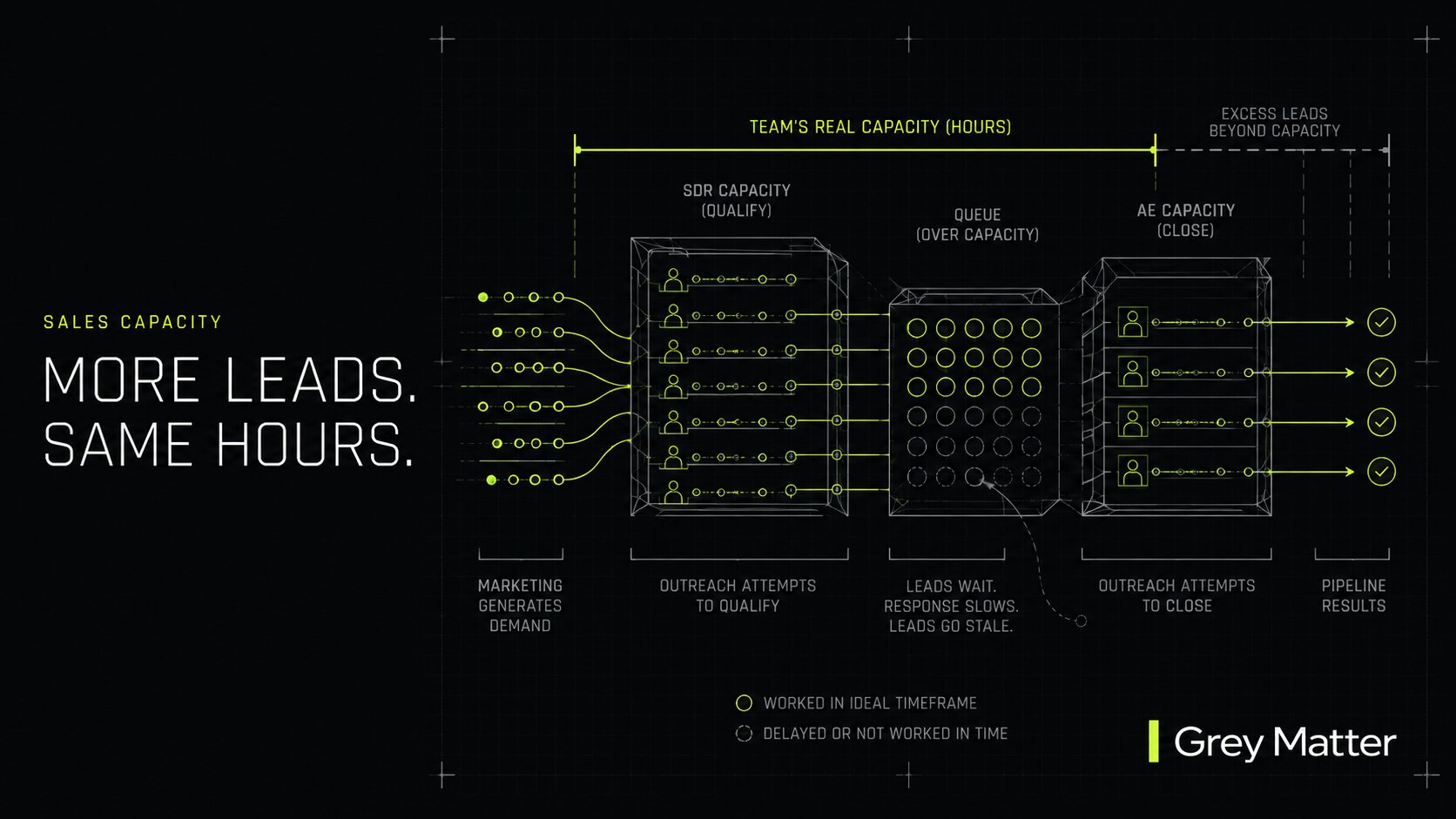
The pipeline review starts the same way every month. Marketing’s slide shows MQLs up 22%. Sales’ slide shows pipeline flat, maybe down. Twenty minutes get spent arguing about lead quality before anyone asks the question that actually matters: did sales have the bandwidth to work the leads marketing sent them?
The Metric Everyone Reports, and the One Nobody Does
Every marketing organization tracks MQL volume, cost per lead, and conversion rate. Every sales organization tracks quota attainment and close rate. What almost nobody tracks is the number that sits between those two dashboards: how many leads a rep can actually work well in a given month.
Reps have a fixed number of outreach attempts they can make in a day, and every lead needs a certain number of those attempts to get qualified or closed. Multiply it out and you get a real ceiling. Most B2B teams have never run that math, so the ceiling stays invisible until volume runs past it.
When that happens, the postmortem almost always blames lead quality. Marketing gets told the leads were not good enough. What actually happened is there were more leads than hours, and nobody had the number to prove it before the argument started.
What Actually Happens When Volume Outpaces Capacity
The instinct is to assume that leads over capacity just get ignored. That is not usually what happens. What actually happens is worse: every lead still gets touched, just more shallowly and later than it should. Fewer attempts. Slower first response. Less personalization on the fifth email of the day than the first.
Response time is one of the best-documented variables in B2B sales, and the research on it is not close. The 2007 MIT Lead Response Management Study, run by Dr. James Oldroyd at MIT Sloan with InsideSales.com, analyzed over 15,000 leads and more than 100,000 call attempts across six companies. Reps who contacted a lead within five minutes were roughly 100 times more likely to reach that person, and 21 times more likely to actually qualify them, compared to reps who waited 30 minutes.
Harvard Business Review followed up in 2011 with a larger, blunter audit: 2,241 US companies, sent real test leads, timed and tracked. The average response time across the group was 42 hours. Nearly one in four companies never responded at all. The firms that responded within an hour were about 7 times more likely to have a real qualifying conversation than the ones that waited longer.
None of that is a coincidence and none of it is really about laziness. It is what happens when the volume coming in exceeds the hours available to work it. The lead does not get lost. It gets deprioritized in favor of whatever is newest in the queue, and by the time someone circles back, the buyer has already talked to someone else.
That drop shows up in the numbers as a soft conversion rate. It rarely shows up as “we did not have capacity.” It gets read as a lead quality problem, and the next quarter’s fix is usually more targeting, more content, and better forms. All useful things, but none of them fix a capacity problem.
The SDR/AE Handoff Makes This Worse, Not Better
Teams with a two-stage model, SDRs qualifying and AEs closing, have a second failure point layered on top of the first: the two stages almost never have matched capacity.
If SDRs are producing 200 qualified leads a month and AEs, given their outreach volume and touches needed per deal, can realistically work 140, that leaves 60 qualified leads a month getting worked at half the intended cadence, sitting in someone’s queue, or going stale before an AE gets to them. From the outside, it looks like AEs are not converting well. From the inside, AEs are drowning in a backlog that was sized for a team twice their headcount.
Run it the other way and it is just as bad. AEs with room to spare and SDRs who cannot keep the funnel full means reps sitting idle while marketing gets blamed for underperforming.
Most teams do not know which direction their imbalance runs, because nobody has calculated either side of it separately. They just know something feels off between the two teams, and the meetings where that gets discussed tend to be unproductive for exactly that reason.
Do the Math Before You Debate It
Figuring this out takes four or five numbers most teams already have: rep count on each side, outreach attempts per rep per day, and touches needed to qualify or close.
We built a Sales Team Capacity Calculator to make that math take five minutes instead of a spreadsheet. Plug in your SDR and AE numbers separately, and it shows you where the real bottleneck sits, what your team’s true monthly throughput is, and how your current or planned lead volume stacks up against it. If one side is starving the other, it tells you which one and by how much.
Run your own numbers before the next pipeline review. It changes the conversation from “the leads were bad” to “here is the actual ceiling, and here is what we do about it.”
What To Do With the Number
If you are under capacity, that is good news you are probably not using. There is room to increase lead volume without adding headcount, which is a much easier budget conversation than asking for another rep.
If you are over capacity, the fix is not automatically more hires. Sometimes it is cutting the number of touches required to qualify a lead by tightening the criteria upstream. Sometimes it is fixing the ratio between SDRs and AEs before you fix the total count. Adding headcount to a team that is imbalanced just makes a bigger version of the same imbalance.
Marketing can hit every number on its dashboard and the business can still lose. Capacity is the number that decides which one happens, and almost nobody is calculating it before the leads start flowing.
Run the math first. It is a lot cheaper than finding out in the pipeline review.
Want help building the reporting infrastructure that connects lead volume to what sales can actually work? Our Sales Enablement team builds the capacity models and handoff processes that keep marketing and sales working off the same number.
Want a strategy built around this? Get a free B2B marketing diagnostic →