Sales and Marketing Alignment: Before You Ask for More Leads, Listen to Your Phones
Sales and marketing alignment often breaks after the lead arrives. What one client learned when it started listening to its phone calls, and a one-week diagnostic to check yours.
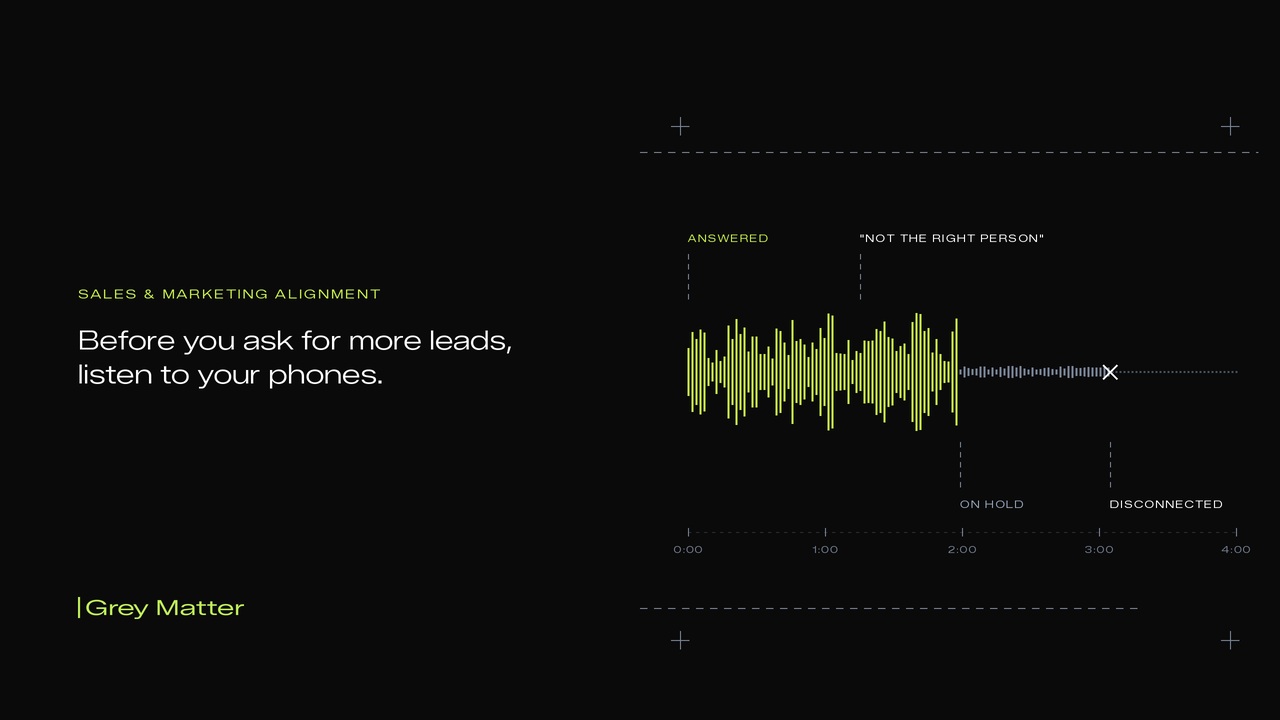
Sales and marketing alignment is an agreement between the two teams on what a qualified lead is, who handles each inquiry, how fast, and how the results get reported, with both teams measured on the revenue those leads produce. Most alignment advice stops at the lead definition. The expensive failures tend to happen in the first conversation after the lead arrives.
We ran marketing for a multi-branch industrial waste disposal and cleanup company for several years. Early on, the numbers looked healthy from our side: about 276 inquiries a month at $29 each.
The CRO’s message in nearly every meeting was that they needed more leads. Revenue was short of plan, and lead volume was the lever everyone in the room knew how to pull. Our own first ROI report to them listed two ways to grow revenue: raise the close rate, or spend more on ads.
The close rate was 7%. The average time to reply to an inquiry was seven days.
That second number sent us looking at what happened to inquiries after they arrived. We had them install CallRail so calls could be tracked and recorded. For the year, the company logged over 8,000 phone calls to headquarters and branches against fewer than 800 form fills. Roughly nine of every ten inquiries were phone calls, which told us the calls were where the problem was. The forms everyone had been judging marketing on were a small slice of demand. CallRail’s scoring put about half of the branch calls in the qualified column.
Then we listened to the recordings. The people answering didn’t know how to handle a buyer. Callers were told “I’m not the right person” and left with no name or callback. Some were hung up on. Basic questions went unanswered, and callers who needed a quote weren’t sent to anyone who could give one.
More ad spend would have sent more qualified buyers to the same people who were turning them away. Then we wrote a call script for the people answering the phones, built around what callers needed and where to send each type of request. Once calls were handled with the script, phone leads started turning into pipeline and closed revenue.
Why Does Sales Keep Asking for More Leads?
Sales asks for more leads because volume is the one funnel number most teams can see. The rest usually stays hidden, for three reasons.
- Calls don’t show up in most marketing reports. Forms are easy to count, so dashboards count forms. Without call tracking, a company like the one above would be judging marketing on about a tenth of its inquiries.
- Nobody owns the first conversation. Marketing’s job ends when the lead arrives, and sales assumes qualified leads will reach them. The receptionist, dispatcher, branch office manager, or shared inbox sits in between, and none of them are measured on revenue. In many industrial companies those people report to operations, not sales.
- Response time isn’t on anyone’s report. A seven-day reply time can sit for months if no one pulls the number.
A 2011 Harvard Business Review audit of 2,241 U.S. companies found that firms contacting a web lead within an hour were nearly seven times as likely to qualify it as firms that waited even an hour longer. The average response time among companies that responded at all was 42 hours.
How to Tell If You Need More Leads or Better Lead Handling
Run this before you approve a bigger lead-generation budget. If you already track calls, most of it fits in a week. If you don’t, start with step 1 and give it 30 days of data.
- Count every inquiry by channel. Forms, calls to the main line, calls to branches or reps, chat, and email. If calls aren’t tracked, set up call tracking first (CallRail, CallTrackingMetrics, or your phone system’s reporting). Recording laws vary by state, so add a recording disclosure to the greeting.
- Listen to 20 recent inbound calls. Score each one on four questions. Was it answered by a person? Did the caller reach someone who could help? Were their questions answered? Did they leave with a named contact and a next step? Treat 15 of 20 as a starting bar and adjust it once you have a baseline. While you listen, note every “I’m not the right person,” every hold that ends in a dropped call, and every question the person answering couldn’t handle.
- Call your own company. Call the main number and two branch or rep lines the way a buyer would, once during business hours and once after 5 p.m. Ask a real service question and write down what happens.
- Check time to first response on forms. Pull the last 50 form fills and find when a person first replied. Look at where forms are delivered. A shared inbox with no owner is a common reason replies take days.
- Compare lead-to-quote rates by channel. When calls and forms come from the same campaigns, a channel that quotes far below the others points to a handling problem in that channel.
Unqualified calls mean marketing should fix targeting and messaging before any budget increase. Qualified calls that go nowhere mean you spend on handling before you spend on leads. Save your step 2 scores, because they are the baseline you’ll use to prove the fix worked.
How to Align Sales and Marketing Around Every Inquiry
- Agree on what a qualified lead is, in writing, with criteria both teams accept, and apply it to calls as well as forms.
- Put a name on every inquiry channel. Main line, branch lines, forms, chat, and email each get an owner and a backup. If the front desk reports to operations, the head of operations needs to be in this conversation, not only sales and marketing.
- Write a one-page call script. A greeting that confirms the company, three qualifying questions (what do you need, where, how soon), and a routing sheet that lists who quotes each service in each location, with a backup when that person is on a job site. The script’s one hard rule: no qualified caller hangs up without a named person and a time for the next conversation.
- Set a response standard for every channel. A person answers calls during business hours, forms and voicemails get a callback within an hour, and urgent after-hours calls have a defined path. The one-hour callback only works when the routing sheet names a backup.
- Send call data into the CRM. Call tracking connected to your CRM lets you treat calls as leads, attribute them to campaigns, and follow them to closed revenue.
- Review calls together weekly. Marketing and sales leaders listen to five calls together in a 30-minute session, so lead-quality arguments rest on calls both teams heard.
Once handling works, hold marketing to qualified conversations and pipeline instead of raw lead count. If your sales team is also at capacity, fix that in parallel. We covered the capacity side in Marketing Hit Its Number. Sales Still Missed Theirs.
Sales and Marketing Alignment Metrics to Review Weekly
| Metric | What it tells you | Usual owner |
|---|---|---|
| Inquiries by channel (calls, forms, chat, email) | Where demand comes in | Marketing |
| Live answer rate on inbound calls | Whether buyers reach a person | Operations or sales |
| Calls reaching the right person on the first transfer | Whether routing works | Operations or sales |
| Time to first response on forms | Whether speed is costing deals | Sales |
| Lead-to-quote rate by channel | Where leads stall | Marketing and sales |
| Quote-to-close rate | Whether the sales process converts | Sales |
When inquiries grow and closed revenue doesn’t, check the middle four rows before you fund more leads.
Grey Matter’s sales enablement team starts with the leads you already have. We set up call tracking, listen to your inbound calls, and build the call script, routing sheet, and weekly call review your team uses to turn inquiries into quotes, before anyone asks for a bigger ad budget. See how we work with sales leaders.
FAQ
What is sales and marketing alignment?
Sales and marketing alignment is an agreement between the two teams on what a qualified lead is, who handles each inquiry, how fast, and how results are reported, with both teams measured on revenue. It covers what happens after a lead arrives, not only how leads are generated.
How do you align sales and marketing?
Agree on a written lead definition, assign an owner and backup to every inquiry channel, set response standards, script the first conversation, connect call tracking to your CRM, and review real calls together every week.
How do you know if you need more leads or better lead handling?
Listen to 20 recent inbound calls and check time to first response on forms. If qualified buyers are calling and not reaching someone who can help, more leads won’t raise revenue until handling is fixed.
How fast should sales respond to a new lead?
Within an hour for forms and voicemails, and live during business hours for calls. A 2011 Harvard Business Review audit of 2,241 companies found firms that responded within an hour were nearly seven times as likely to qualify the lead.
What is smarketing?
Smarketing is sales and marketing operating as one revenue team with shared goals, data, and reporting. It works when it covers operating details like who answers the phone and how fast forms get a reply.
Does sales and marketing alignment look different for manufacturers?
The principles hold, but manufacturing sales cycles are longer and involve more technical buyers. See Marketing and Sales Alignment in Manufacturing for the industry-specific version.
Want a strategy built around this? Get a free B2B marketing diagnostic →