Google I/O 2026 Just Rewrote the Search Playbook. Here's What B2B Marketers Should Actually Do About It.
Google made AI Mode the default Search experience this week. The 25-year-old ten blue links interface that the entire B2B search playbook was built around is no longer the default. Here's what changed, what it breaks, and what B2B marketers should do about it right now.
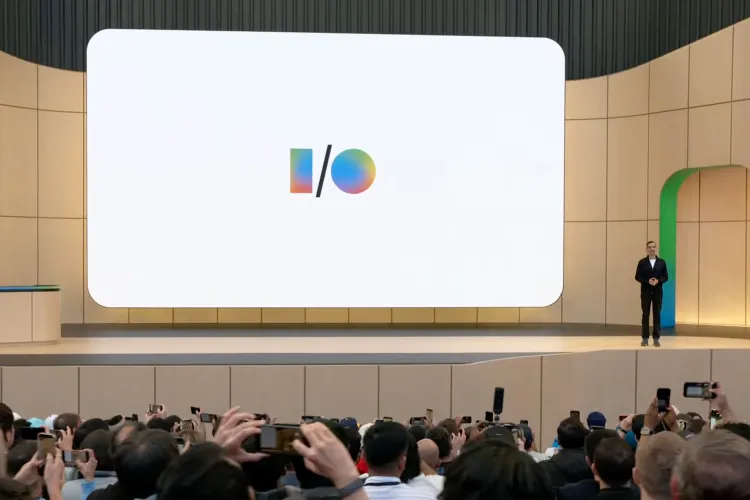
Google’s I/O announcements this week weren’t subtle. AI Mode, the conversational, Gemini-powered Search experience, has passed 1 billion monthly users and is now the default Search box globally. AI Overviews and AI Mode have been merged into a single, continuous AI Search experience. New ad formats put a Gemini-generated explainer right next to your creative. Information agents will soon run background research on behalf of buyers, 24/7, monitoring topics and synthesizing updates and delivering them back without the buyer ever returning to a search box.
If you work in B2B marketing or paid search, the natural reaction is to file this under “interesting, will keep an eye on it.” That reaction is going to age badly.
The shift isn’t about whether AI Mode is good or whether Gemini’s explainers are accurate. The shift is that Google has formally moved past the search interface that the entire B2B playbook was built around. Keyword strategies, ad copy frameworks, click-through-rate benchmarks, landing page conventions, attribution models, all of it was designed for a search environment where buyers scanned a list of ten results and made their own filtering decisions.
That environment is now the secondary experience. The primary one is a synthesized answer, with sources cited, sometimes with an ad woven into the response, often without a click happening at all.
What Actually Changed at I/O (the parts that matter for B2B)
Google announced roughly 100 things at I/O. Most of them don’t matter for B2B paid search and SEO. A few do, and they’re all variations on the same theme: AI is now sitting between the buyer and the brand, and Google is the one operating it.
AI Mode is now the default Search experience, powered by Gemini 2.5 Flash. AI Mode queries have more than doubled every quarter since launch. The “new intelligent Search box” replaces the traditional one across desktop and mobile, globally. You search using text, images, files, videos, or Chrome tabs, and Search reasons across all of them.
AI Overviews and AI Mode are now one continuous experience. You ask a question, get an AI Overview, then flow into AI Mode for follow-ups, all without leaving the page. The buyer’s research journey is increasingly happening inside a single conversation with Google rather than across multiple tabs and visits to vendor sites.
Conversational Discovery ads and Highlighted Answers. Both formats put your ad creative next to a Gemini-generated “independent AI explainer” that synthesizes information about your product or service. Google’s framing is that this builds trust and transparency. The practical reality is that Gemini is now writing a second piece of ad copy that sits next to yours, drawn from sources Gemini considers authoritative, and you don’t control what it says.
AI-powered Shopping ads and Business Agent for Leads. Shopping ads now include a custom Gemini-written explainer pulling from your product data. Business Agent for Leads embeds a chat agent directly inside the ad unit so a prospect can ask questions and get answers drawn from your website before they ever land on it.
Information agents. Buyers can soon spin up multiple AI agents inside Search that monitor topics 24/7 and send synthesized updates back to them. This is going to change how upper-funnel research happens. A prospect researching vendors in your space may set up an information agent in week one and only re-engage with the actual brands months later when the agent surfaces something specific.
Universal Cart and Universal Commerce Protocol. Buyers can add products to a unified cart from Search, Gemini, YouTube, or Gmail, and check out directly on Google through UCP. More relevant for retail and e-commerce than B2B, but the pattern matters: more of the buying journey is moving inside Google’s surfaces and away from vendor sites.
Personal Intelligence. AI Mode now connects to Gmail, Google Photos, and soon Google Calendar, with the buyer’s permission. Search responses can pull from the buyer’s own email and files alongside web content.
The Structural Shift Underneath the Announcements
We wrote a few weeks ago about why agentic search is a different game than SEO. The short version: in traditional search, the buyer sees ten results and does the filtering. In agentic search, the AI synthesizes a single answer from sources it considers authoritative. Your content is either part of the synthesis or it’s invisible. There’s no page two.
What Google announced at I/O is that the dynamic we described for ChatGPT, Perplexity, and Claude is now also true inside Google itself. The synthesis is happening on the platform that still dominates B2B research volume, with ads woven into the synthesized response, with Gemini writing the explainer that sits next to your creative.
What This Breaks in the Existing B2B Search Playbook
Keyword-led SEO loses leverage when buyers ask conversational questions. B2B buyers researching “industrial automation solutions” still exist, but the volume is shifting toward problem-shaped questions like “how do I reduce changeover time on my packaging line without retraining operators.” Pages optimized for short, generic keyword phrases don’t get cited in synthesized answers the way pages that thoroughly address specific problems do. The fundamentals of SEO still matter. The content that gets cited is thorough, specific, and demonstrably authoritative on the buyer’s actual problem.
Click-through rates on traditional Search results will keep compressing. This trend has been happening for years and is about to accelerate. If a buyer’s question gets answered fully inside the AI Overview and AI Mode flow, with sources cited and follow-up questions handled inline, the click to your site doesn’t happen. Your organic traffic numbers may decline even as your visibility in AI responses increases. The metric that matters is shifting from sessions to citations, and most B2B companies aren’t measuring it.
Ad copy as a craft is changing. When Gemini writes an “independent” explainer next to your ad creative, your headline and description aren’t the whole story anymore. The explainer is drawing from your structured product data, your website content, third-party reviews, and whatever else Gemini deems authoritative on the topic. That means the inputs to your ad performance now include your product feed quality, your content depth, your review presence, and your overall brand reputation across the web.
Business Agent for Leads is essentially a discovery call running 24/7. A prospect researching a complex B2B purchase can now click “Chat” inside your ad and start a real conversation, with an agent drawing answers from your website. That’s a major shift in how lead qualification happens. If your site doesn’t have the answers to the questions buyers actually ask on discovery calls, the agent will give vague or incomplete responses, and the lead won’t convert. If your site does have the answers, the agent becomes a qualification engine that never sleeps.
Attribution gets harder before it gets better. Buyers will research entire decisions inside AI Mode, Universal Cart, and Personal Intelligence without clicking through to vendor sites the way they used to. Last-touch attribution was already broken for B2B. It’s about to get worse. The work to fix it, closed-loop CRM data feeding back into ad platforms, multi-touch attribution models, sales-captured deal influence data, isn’t optional anymore. It’s the only way to know what’s working.
What B2B Marketers Should Actually Do About It
1. Audit your visibility inside AI Mode the same way you’d audit it on ChatGPT or Perplexity. Generate 10 problem-shaped buyer questions, run them through AI Mode in fresh sessions with no context, and document what comes back. Note which sources get cited, what content the AI references, whether your competitors appear, and whether the synthesized answers align with how your company positions itself. This is the diagnostic step. You can’t fix a visibility gap you can’t see.
2. Restructure content for synthesis, not just ranking. The content patterns that get cited in AI Mode are the same ones that get cited in ChatGPT and Claude: thorough treatment of the buyer’s problem, specific data and examples, claims backed up with evidence, multiple pieces across the topic giving the AI multiple signals of authority. Thin content that ranks on domain authority alone won’t make it into the synthesis. The fix isn’t to abandon SEO. It’s to build content that performs in both environments — pages that rank and pages that get cited are increasingly the same pages, built the same way. For a full breakdown of the framework, see our guide to generative engine optimization for B2B.
3. Get your product data and structured content in order. AI-powered Shopping ads pull from product feeds. Highlighted Answers and Conversational Discovery explainers draw from structured content across your site. Business Agent for Leads pulls from whatever your website says about your offering. The quality of these AI-generated outputs is bounded by the quality of the inputs you give Google. Sparse product descriptions, outdated specifications, missing FAQ sections, all of that surfaces in the AI-generated content sitting next to your ad. Cleaning up your structured data and content isn’t a background task anymore. It directly affects what Gemini says about you.
4. Test Performance Max and AI Max for Search deliberately, not by default. Google has positioned both as the foundation for the new ad formats. That doesn’t mean you should hand the controls over without measurement guardrails. These tools work best when they’re fed clean conversion data, ideally from a CRM that tracks deals through to close rather than form fills. They also work best when you have clear performance baselines from manual campaigns to compare against. The right move is a structured test with defined success metrics, not a wholesale migration driven by platform recommendations.
5. Treat the new ad formats as research surfaces, not just performance channels. Business Agent for Leads is the clearest example. Every conversation a prospect has with that agent is real buyer intelligence about what questions get asked, what objections come up, and what content the agent didn’t have a good answer for. The same is true for Conversational Discovery ads, where Gemini is essentially showing you what buyers are asking about your category. The companies that capture and act on that intelligence will build a compounding advantage. The ones that treat it purely as a conversion channel will miss it entirely.
The Bigger Pattern
Companies that have captured real buyer intelligence, in their CRM, in their sales notes, in structured content across their site, have something for these AI surfaces to synthesize. Their product data is clean enough to power Shopping ads. Their content is deep enough to get cited in AI Mode. Their sales conversations have been documented in enough detail that Business Agent for Leads can actually answer prospect questions. Their conversion data is clean enough to make Performance Max work.
Companies that haven’t built that foundation are going to be invisible in AI Mode the same way they’re already invisible in ChatGPT. The gap won’t show up as a sudden drop in traffic. It’ll show up as a slow erosion of pipeline quality, as competitors who started earlier consistently get cited in synthesized answers, as Gemini’s explainers next to competitors’ ads make a stronger case than yours, as the buyers who used to click through to your site instead get their questions answered without ever leaving the search page.
The compounding part is what makes this urgent. Every quarter that AI Mode handles more of the buyer’s research journey, the gap between companies that have built for synthesis and companies that haven’t gets wider. The work to close it doesn’t get easier as you wait. The data layer, the content depth, the structured product information, the CRM intelligence that feeds attribution, all of it takes time to build. You can’t sprint to it the quarter after a competitor starts showing up in every synthesized answer your buyers see.
Google has just made the change official. The buyers shifted first. The platform has now followed. The question is whether your marketing strategy follows fast enough to stay visible in the search environment your buyers are actually using.
Not sure where your company stands in AI-powered search? Our B2B Growth Audit includes agentic search visibility analysis, evaluating how your content performs across AI Mode, ChatGPT, Perplexity, and Claude, and identifying the specific gaps costing you discovery. Get your audit here.
Want a strategy built around this? Get a free B2B marketing diagnostic →