Account-Based Marketing for B2B: A Practical ABM Playbook
Account based marketing points your budget at the accounts that can actually buy. The practical ABM playbook: build the list with sales, map the committee, run the plays, and measure to pipeline.
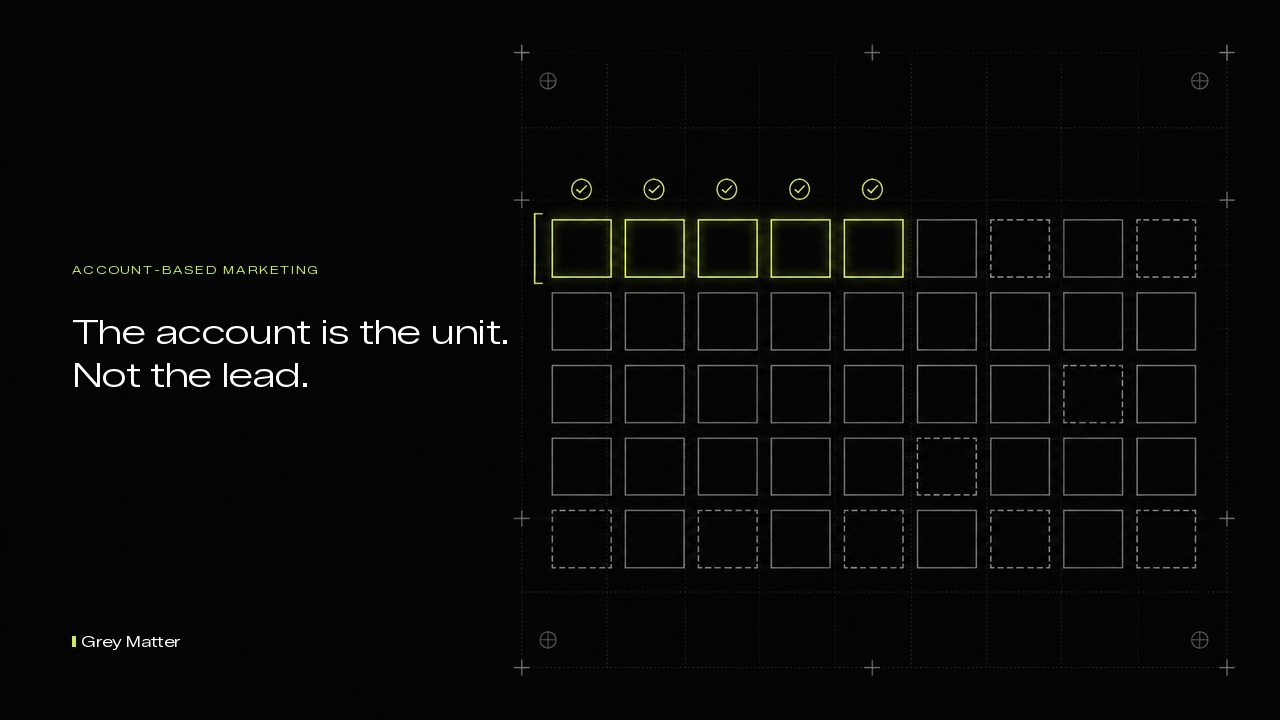
Your sales team has 40 named accounts. Twelve of them hold most of the revenue you can realistically close this year, and every rep can name those twelve without opening a spreadsheet.
Marketing just wrapped a campaign that reached 14,000 contacts and produced 300 form fills. Four of the twelve accounts appear anywhere in the results. Both teams will report the quarter as a win, and the forecast won’t move.
Account based marketing is the decision to stop running that campaign. Instead of buying reach and sorting through whoever responds, you pick the accounts worth winning and build programs aimed at them specifically. Most companies that try it still fail, because they buy a platform, upload 500 accounts, and call the resulting display ads a strategy. This is the version that works.
What Is Account Based Marketing?
Account based marketing is a B2B approach where sales and marketing agree on a defined list of high-value accounts and build coordinated programs for each one, instead of running broad campaigns and filtering the responses. The account is the unit of measurement rather than the individual lead.
That changes what you report on. In a traditional funnel, success is a person who filled out a form. In ABM, success is an account moving from unaware to engaged to in-pipeline, measured by how much of the buying committee is participating and how far the opportunity has advanced. One account with six engaged stakeholders and an open opportunity is worth more to your forecast than 200 form fills from companies you would never quote.
Momentum ITSMA’s research found that 87% of marketers say ABM delivers higher ROI than their other marketing investments. That figure comes with a condition attached, and the condition is everything below.
Why Do Most ABM Programs Fail?
Because they treat ABM as a channel to buy rather than an operating agreement between sales and marketing.
The sequence is consistent enough to predict during an audit. Marketing buys an intent data subscription and an advertising platform. Someone exports every company in the target industry above 200 employees, which returns a list of 800 accounts. Ads go live against all of them. Six months later the report shows impressions and an account engagement score, sales cannot point to a deal that came from any of it, and the line item disappears in the next budget cycle.
Four things cause most of that:
- The list is too long. Account research runs about 20 minutes per account. Across 800 accounts once a quarter, that is 267 hours, and two SDRs only have about 1,040 hours in a quarter. The list commits a quarter of their capacity to reading before a single touch goes out, so the research never happens. One-to-one ABM operates at 10 to 25 accounts per rep for this reason.
- Sales never picked the accounts. When marketing builds the list alone, reps keep working their own pipeline and treat the program as background noise.
- The content is generic. Wrapping the same product page in an account-specific ad is not personalization, and buyers who see it read it as automation.
- The measurement came from demand gen. MQL counts inside an ABM program say nothing about whether an account is progressing. You need coverage, engagement, opportunity creation, and velocity.
Every one of those is determined before launch, during the two weeks of joint planning that most companies skip.
The Three Tiers of ABM
Not every account justifies the same investment, and the most expensive budgeting mistake is treating them as though they do.
| Tier | Accounts | What it looks like | Best for |
|---|---|---|---|
| One-to-one | 5-25 total | Custom research, bespoke content, executive engagement, named plays per account | Six and seven figure deals, strategic logos, key renewals |
| One-to-few | 25-100, clustered | Programs built per cluster of 5-15 accounts sharing an industry, use case, or trigger | Mid-market expansion, vertical pushes |
| One-to-many | 100-1,000 | Personalized at the segment level, powered by intent data and automation | Broad ICP coverage, pipeline volume |
Most companies should run two tiers at once: a short one-to-one list for the accounts that would change the year, with a one-to-few program underneath it. Programs that run only the one-to-many tier produce most of the “we tried ABM and it didn’t work” stories, because at that tier the work is closer to segment marketing than to ABM and should be judged accordingly.
The ABM Playbook: Six Phases
Phase 1: Build the account list with sales in the room
Get sales leadership, your best two or three reps, and marketing into a half-day working session. Bring three inputs: a closed-won analysis covering the last 24 months, your current ICP definition, and whatever intent or technographic data you have access to.
Score each candidate on two axes. Fit is whether the account resembles the ones you already win, measured on industry, size, structure, and tech stack. Signal is whether something is happening right now that creates a reason to buy: a funding round, a leadership change, a new facility, an expiring contract with a competitor. High fit with no signal goes on the bench for later. Signal without fit goes nowhere.
Then cut the list. A reasonable test is whether your reps can recite it from memory.
Phase 2: Map the buying committee
Gartner puts the typical B2B buying group at six to ten stakeholders, each arriving with four or five pieces of research they gathered on their own. A program that reaches only your champion is addressing 10 to 15% of the decision, and the champion is rarely the person who kills the deal.
For each target account, name the actual people behind the roles: economic buyer, technical evaluator, day-to-day user, procurement, and the skeptic who raises the objection in a meeting you are not invited to. Next to each name, write down what that person is measured on. A CFO and a plant manager evaluating the same purchase are answering different questions, and a single piece of content will not answer both.
Phase 3: Build the account plan around their problem
Generic ABM content fails for the same reason generic website copy fails. It leads with what you sell. Account-level content works when it opens with something specific and verifiable about the account’s situation.
Weak: “Our platform helps manufacturers improve operational efficiency.”
Strong: “You opened a second line in Monterrey in March and your careers page lists four open quality engineer roles. Here’s how three other multi-plant manufacturers standardized quality reporting across sites in under 90 days.”
The second version takes about 20 minutes of research per account: their news page, their job postings, their last earnings call if they are public, and the recent LinkedIn activity of the two people you named in Phase 2. Twenty minutes across 25 accounts is a manageable week of work. Across 800 accounts it is impossible, which is the practical reason the list has to be short.
Phase 4: Run coordinated plays across channels
A play is a sequenced set of touches aimed at one account over a defined window, run by marketing and sales together. A workable 60-day play for a tier-one account:
- Weeks 1-2: LinkedIn and display running to the mapped committee, plus a landing page built for the account’s industry and use case.
- Weeks 2-4: Email nurture to the committee, with content matched to each role instead of one message sent to all of them.
- Weeks 3-6: Sales outreach referencing the specific trigger, leading with a point of view rather than a meeting request.
- Weeks 5-8: An executive-to-executive touch, a customized assessment, or an invitation to something small and genuinely useful.
Log every touch in the CRM against the account, not just the contact. When sales and marketing run separate sequences into the same buying committee with no shared view, the committee compares notes internally and sees the disorganization before it sees the pitch.
Phase 5: Measure at the account level
Stop reporting MQLs inside an ABM program. Track these instead:
- Account coverage. What percentage of the mapped buying committee do you have contact data and engagement for?
- Account engagement score. Weighted activity from the committee, trended over time. Rising engagement is your leading indicator.
- Opportunity creation rate. Of the accounts on the list, how many opened a qualified opportunity this period?
- Pipeline velocity. Days from first engagement to opportunity, and opportunity to close, for ABM accounts against everything else.
- Average deal size. If ABM accounts are not closing larger than the rest of your pipeline, the account list is the first thing to re-examine.
None of this works without clean attribution underneath it. If you cannot connect an account’s engagement history to a closed deal in your CRM, you will be defending the budget with anecdotes at renewal time. Build that layer before you make channel investment decisions.
Phase 6: Review every 90 days and cut
Run the program in 90-day sprints. At each review, sort the list into accelerating, flat, and dead. Accelerating accounts get more budget and a senior touch. Flat accounts get a different play rather than more volume of the same one. Dead accounts come off the list and get replaced from the bench you built in Phase 1.
Most programs leave the same list in place for a full year, because pulling an account off it feels like admitting a loss. The cost of that is a quarter or more of budget aimed at companies that already answered you by not responding.
Account Based Marketing Examples That Work
Three patterns that consistently produce pipeline:
The trigger play. An account hires a new VP of Operations. Within two weeks, that person receives a research brief on the problem their predecessor left behind, sent by your CEO, with no pitch attached. New executives rebuild their vendor list in the first 120 days, and almost nobody shows up during that window.
The competitive displacement play. You know an account renews with a competitor in Q1. Starting nine months out, you run a migration-focused program to the committee: a switching cost analysis, a side-by-side capability comparison, and a customer reference from a company that made the same move.
The expansion play. An existing customer uses one product in one division. Marketing runs a program to the four adjacent divisions built around what the first division achieved, and your CSM makes the internal introduction. Most B2B companies leave this pipeline untouched.
Each of these starts from a fact you can verify before spending anything: a hire, a renewal date, an account relationship you already have.
ABM Doesn’t Replace Demand Generation
Demand generation builds awareness across your market and keeps the bench full. ABM concentrates resources on the accounts you have already decided matter. Run only ABM and you have nothing feeding the list. Run only demand gen and your best accounts get the same attention as a student downloading a guide.
We have made this argument at length in ABM vs. Demand Generation: Stop Asking the Wrong Questions. In practice the two feed each other. Demand gen surfaces which segments respond, ABM tells you which of those segments produce real deals, and your content strategy has to serve both audiences without writing everything twice.
Frequently Asked Questions
What is account based marketing in simple terms?
It is a B2B strategy where you select a specific list of high-value accounts and build coordinated marketing and sales programs for each one, rather than running broad campaigns and filtering the responses. Success is measured by account progression instead of lead volume.
How many accounts should be on an ABM list?
For one-to-one ABM, 10 to 25 accounts per sales rep. One-to-few programs typically cover 25 to 100 accounts grouped into clusters. If your list runs to several hundred, you are doing segment marketing, which is a legitimate approach but needs different expectations and different measurement.
How long does ABM take to show results?
Account engagement usually moves within 30 to 60 days. Qualified opportunities typically appear in months three through six. Closed revenue tracks your normal sales cycle, so a nine-month cycle means judging the program on pipeline created for the first three quarters.
What is the difference between ABM and lead generation?
Lead generation is measured in individuals who raise their hand. ABM is measured in how much of a named buying committee is engaged and whether the account has an open opportunity.
Do you need an ABM platform to start?
No. You can run a credible one-to-one program with your CRM, LinkedIn, email, and a shared account plan document. Buy tooling once the manual version is working and scale is the constraint.
What is the biggest mistake in ABM strategy?
Selecting the account list without sales. If reps had no say in which accounts made the list, they will not work it, and the program stalls in the second quarter regardless of how good the marketing is.
Start With 25 Accounts, Not 800
Your sales team can already name the accounts that would change the year. That list exists whether or not marketing builds anything around it. Account based marketing is the decision to point your budget at those companies with the same discipline sales already applies to them.
The version that works is smaller than most companies expect going in. Twenty-five accounts, a mapped committee for each, four to six plays, and a review every 90 days. Companies that start there and expand outperform the ones that load 800 accounts into an ad platform and wait.
Want to know which accounts deserve that investment and what it would take to reach them? We build ABM programs that sales actually runs, starting with a joint account selection session and a 90-day play. Talk to us about your target account list.
Want a strategy built around this? Get a free B2B marketing diagnostic →