B2B Positioning: Why Your Sales Team’s Version of It Is Probably Wrong
B2B positioning is the place you hold in a buyer’s mind. Two client stories show what bad positioning costs, plus how it differs from messaging and a template to write yours.
The sales team at an automated waste systems company for hospitals was certain they knew why deals stalled. Cost. Hospital buyers were comparing a large capital purchase against the manual systems they already had, and the reps were sure the number was the obstacle.
So the company built its pitch around return on investment. It ran a webinar on the ROI of automation, aimed at hospital decision-makers. The audience was the right one and the topic was the one sales had asked for. Engagement came in below what the team expected.
That’s the moment most companies decide the webinar was the problem. Wrong title, wrong day, wrong subject line. The positioning underneath it never gets questioned, because everyone inside the building already agrees on it.
What Did the Buyers Say When Someone Finally Asked Them?
We ran a primary research study before touching the message again. We surveyed 125 hospital decision-makers across two size tiers (5,000 to 10,000 employees and 10,000 plus), several decision-making roles, and both public and private institutions. Almost half of the respondents came from the largest tier, which is the hardest group in the category to reach.
The finding was direct. Cost was not what moved these buyers. Hygiene-related risk was: contamination exposure, system breakdowns, the day the legacy process fails in front of patients. The sales team had been positioning the product as the smarter financial choice. The buyers were weighing it as the safer operational one.
The fix was not a new tagline. It was a new answer to the question “why us, and why now?” The position moved from the economics of automation to the risk of staying manual, aimed at the segments most likely to feel that risk. The research also gave the team a segmentation strategy, so outreach went first to hospitals most likely to be ready to act.
Why Does a Company Position Itself Wrong in the First Place?
Because the people writing the position are the ones closest to the product. They describe what they build, or they repeat the objection they hear most in sales calls. Neither is the same thing as the reason a buyer picks you.
A second company shows the other common version. It sells Apple device management to mid-market IT teams. Its customers loved the product and valued the automation and ease of use. But the buyers it most wanted to win, IT leaders at companies with lean teams, saw it two ways at once: too simple compared to the long-standing incumbent, and less credible than the big enterprise platforms.
Nothing was wrong with the product. The position had drifted into a gap where it looked like a compromise to everyone. We interviewed stakeholders and customers, surveyed 417 IT decision-makers, and read through community forums where those buyers talk to each other when no vendor is listening. The ideal customer came into focus: companies with 300 to 2,000 employees, small IT teams, and compliance requirements they couldn’t staff their way out of.
The new position stopped trying to answer the incumbent and the enterprise platforms on their own terms. It anchored on Apple-first simplicity, compliance automation, and an easy migration. Sales and customer-facing teams were then trained on the research, the personas, and the buyer journey, so the same story came out of every conversation.
Both companies had real products and capable teams. Both were describing themselves in a way their buyers didn’t use.
What Is B2B Positioning?
B2B positioning is the specific place your company holds in a buyer’s mind relative to the alternatives. It defines who you serve, which problem you solve for them, what category you compete in, and why you are the better choice for that buyer. It is a strategic decision, not a piece of copy.
Positioning answers one question: when a buyer with your target problem weighs their options, where do you sit, and why? Notice that in both stories above, the answer the company believed and the answer the buyers held were different.
Done well, it does three jobs:
- It tells a buyer in under ten seconds whether you are for them.
- It gives your team one answer to “what do you do and why you?”
- It makes pricing, sales cycle, and content decisions easier, because you know what you are not.
How Is B2B Positioning Different From Messaging?
Positioning is the decision. Messaging is how you say it. Positioning sets the claim you own in the market. Messaging turns that claim into words for each audience, channel, and stage of the buying process.
The hospital company’s webinar was a messaging asset built on a positioning assumption nobody had tested. Better copy would not have rescued it.
| Positioning | Messaging | |
|---|---|---|
| What it is | The strategic position you hold against alternatives | The language that communicates that position |
| Question it answers | Who are we for, and why are we the better choice? | What do we say to this person, here, now? |
| Changes | Rarely. Every few years or after a market shift | Often. By persona, channel, and campaign |
| Owner | Leadership | Marketing and sales |
| Output | A positioning statement and a competitive frame | Value props, headlines, talk tracks, email copy |
Positioning comes first. If you skip it, messaging turns into whatever the loudest stakeholder prefers this quarter. Our guide to problem-centric messaging for B2B covers how to build the messaging half. This post covers the layer underneath it.
What Does Solution Messaging Have to Do With Positioning?
Solution messaging describes how your offering resolves a specific problem, and it only works when positioning has already told you which problem to lead with.
Most teams write solution messaging first: “Our platform streamlines your workflow with end-to-end visibility.” Any competitor could paste that on their site. Positioning forces specificity upstream.
- Bad: “We help manufacturers improve efficiency.”
- Good: “We help 50 to 500 person industrial manufacturers replace trade-show-dependent pipeline with a repeatable inbound system.”
The second version is a positioning claim. Once you have it, the problem, the buyer, and the alternative you beat are all named.
How Do You Write a B2B Positioning Statement?
Write it in one sentence using five inputs: target buyer, problem, category, differentiator, and proof. Fill in the template, then test it against your real competitors and your last ten closed deals.
For [specific target buyer] who [specific problem or trigger], [Company] is the [category] that [primary benefit]. Unlike [main alternative], we [key differentiator], proven by [specific evidence].
A filled-in example:
For marketing directors at industrial manufacturers with 50 to 500 employees who rely on trade shows for pipeline, Grey Matter is the B2B growth partner that builds a repeatable inbound system. Unlike general agencies that report on traffic, we tie every program to qualified pipeline, proven by reporting buyers can trace from first visit to closed deal.
Work it in five steps:
- Define the buyer. Start from your ideal customer profile, not your whole customer list. Pick the segment where you win most often and keep the customer longest.
- Name the problem in their words. Pull phrases from sales calls and lost-deal notes, then map them with a problem-persona matrix so each role in the buying committee sees their own problem.
- Pick the competitive frame. Who does the buyer compare you to? Often it isn’t another vendor. It’s a spreadsheet, an in-house hire, or doing nothing.
- State the differentiator you can prove. If a competitor can truthfully say the same sentence, cut it.
- Check it against buyers, not your own team. This is the step both companies above skipped. A survey of 100 to 150 people in your target segment will tell you more than a month of internal workshops.
How Do You Test Whether Your Positioning Works?
Test it against buyers, not stakeholders. A position is working if prospects repeat it back accurately and your win rate improves in the target segment.
- The ten-second test. Show your homepage hero to five people in your target segment for ten seconds. Ask what you do and who it’s for. If fewer than four get it right, the position is unclear.
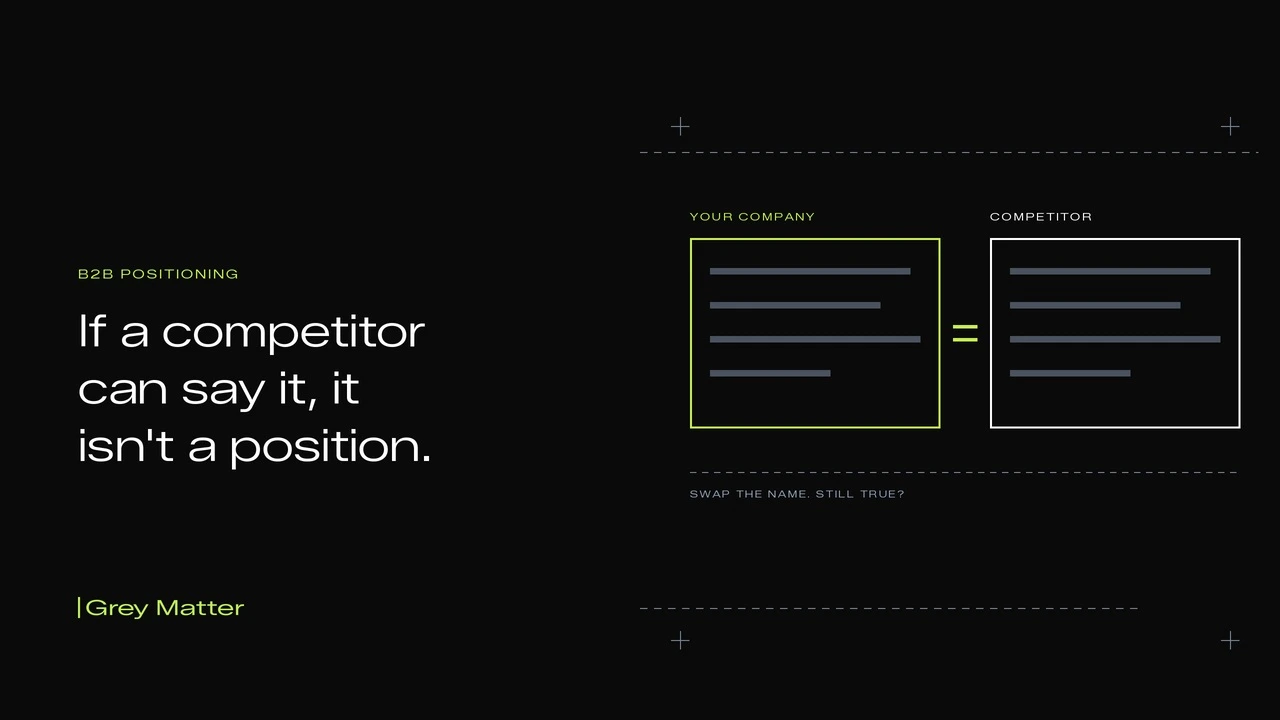
- The swap test. Replace your company name with a competitor’s. If the statement still reads true, it isn’t a position.
- The sales call test. Listen to ten recorded calls. If reps describe the company differently, you have a positioning gap, not a training gap.
- The loss test. Review your last ten losses. If you lost on price or “went with the incumbent,” your position didn’t create enough separation. The hospital company’s sales team read losses as a cost problem. The buyers saw a risk problem.
Track win rate in the target segment, average deal size, and sales cycle length over two quarters. Positioning changes show up there first.
What Happens After You Set Your Position?
You build everything else on it: messaging by persona, website structure, sales decks, paid campaigns, and content. Each asset either reinforces the position or dilutes it. This is where B2B brand positioning pays off financially. A clear position lets you say no to bad-fit deals, charge for specialization, and shorten explanation time in every sales conversation.
Skipping it costs less visibly than a failed campaign. It shows up as discounting, long cycles, and a pipeline full of buyers who never understood why you were different. If your team is certain they know why deals stall, ask the buyers before you build another campaign around the answer.
Grey Matter helps B2B companies find out where they stand with buyers before deciding what to say. We start with research, build the position, then the messaging on top of it. See our B2B branding services or start with a free digital marketing audit.
FAQ
What is B2B positioning?
B2B positioning is the position a company holds in a buyer’s mind relative to competing options. It defines the target buyer, the problem solved, the category, and the reason to choose you over alternatives.
What is the difference between positioning and messaging?
Positioning is the strategic decision about where you stand in the market. Messaging is the language you use to communicate that position to specific audiences. Positioning comes first and changes rarely. Messaging adapts by persona, channel, and campaign.
What is B2B brand positioning?
B2B brand positioning is how a company wants to be perceived by its target buyers: the specific problem it owns, the category it competes in, and the proof behind its claim. It guides brand, website, sales, and content decisions.
What is a positioning statement example?
“For marketing directors at industrial manufacturers with 50 to 500 employees who rely on trade shows for pipeline, [Company] is the B2B growth partner that builds a repeatable inbound system. Unlike general agencies that report on traffic, we tie every program to qualified pipeline.”
What is solution messaging?
Solution messaging explains how your offering resolves a specific buyer problem. It depends on positioning to tell you which problem, which buyer, and which alternative to address.
How do you know if your positioning is wrong?
Common signs: your team describes the company in different ways, you lose mostly on price, campaigns draw the right audience but weak engagement, or buyers describe your value differently than you do. Asking 100 or more buyers in your target segment is the fastest way to confirm it.
How often should you update B2B positioning?
Review it annually and rewrite it after a major shift: a new target segment, a new product line, a competitor repositioning, or a change in how buyers describe the problem. Messaging can change monthly. Positioning should not.
Want a strategy built around this? Get a free B2B marketing diagnostic →